
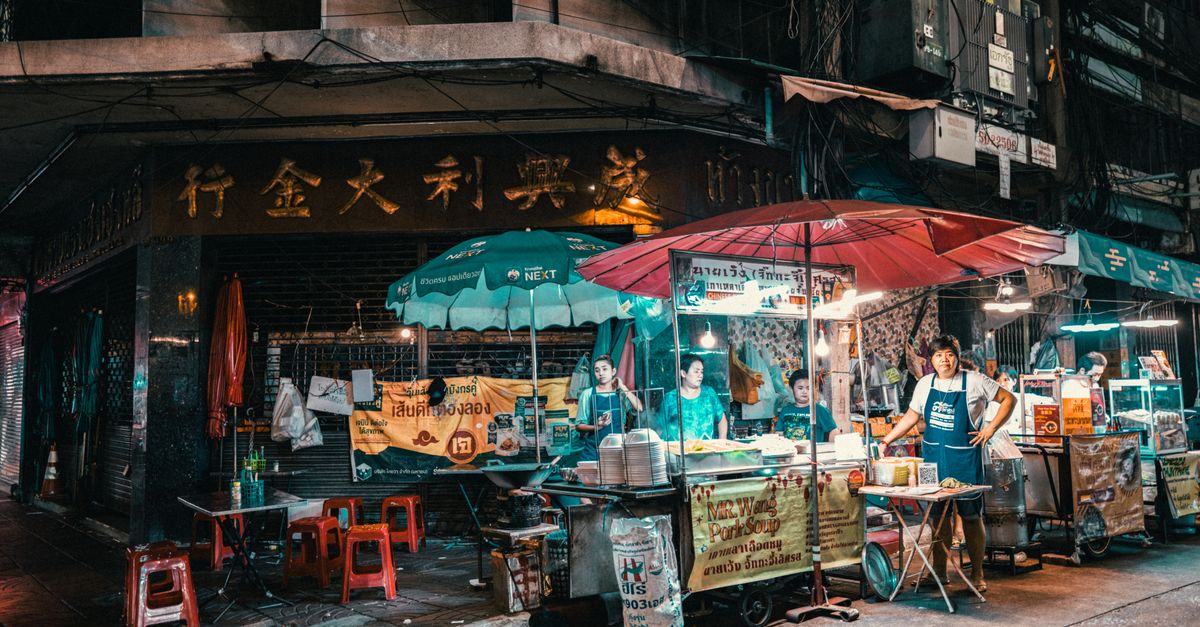
Eating is one of the great joys of a Thai trip, and you rarely need a reservation to enjoy the best of it. Some of the most memorable meals come from a single wok on a pavement. This guide covers what to order, where to find it and how to eat it.
Signature dishes to try
- Pad kra pao: stir-fried holy basil with minced pork or chicken over rice, usually topped with a crispy fried egg. It is the go-to lunch for countless Thais.
- Tom yum goong: hot and sour prawn soup scented with lemongrass, galangal and lime leaf.
- Gaeng keow wan: green curry, rich with coconut milk and small round Thai aubergines.
- Massaman curry: milder and slightly sweet, with potatoes, peanuts and warm spices.
- Pad thai: stir-fried rice noodles with tamarind, egg, tofu or prawns and crushed peanuts.
- Khao niao mamuang: mango with sticky rice and salty-sweet coconut cream, best in the hot season when mangoes are at their peak.
Get your Thailand eSIM in 30 seconds
Instant delivery, 4G/5G speeds, no roaming bills.
Street food and night markets
Street food is everyday food in Thailand, not a novelty. Look for stalls with a steady stream of local customers and a fast turnover, and follow the smoke to charcoal grills selling moo ping (sweet grilled pork skewers) and gai yang (grilled chicken).
Good places to start:
- Yaowarat Road in Bangkok's Chinatown after dark
- Chiang Mai's Sunday Walking Street and the stalls around Chang Phueak Gate
- The weekend and night markets found in almost every Thai town
Many stalls specialise in a single dish, so it is normal to order from several vendors and share at a communal table.
Regional flavours
Thai food changes noticeably as you travel. In the north, try khao soi, a curry noodle soup topped with crispy noodles, and sai oua, a herby grilled sausage. The northeast, known as Isan, is the home of som tam (green papaya salad), larb (minced meat salad with toasted rice) and sticky rice eaten by hand. Southern cooking is the fieriest of all, with turmeric-yellow curries and plenty of fresh seafood along both coasts.
What to drink
- Cha yen: sweet, orange-hued Thai iced tea with condensed milk.
- Fresh coconuts and fruit shakes: sold almost everywhere and the easiest way to cool down.
- Local lagers: crisp beers that pair well with spicy food, often served over ice.
- Lao khao: a potent rice spirit, mostly found in rural areas, so sip carefully.
Most visitors drink bottled or filtered water rather than tap water, and refill stations are common in towns.
How to order, eat and tip
Thai meals are shared. Order a few dishes for the table and eat them with rice. The spoon, held in the right hand, does the work, and the fork is only for pushing food onto it; chopsticks are used for noodle soups. Putting the fork in your mouth marks you out as a newcomer.
Nobody expects a tip at a street stall. In sit-down restaurants, leaving loose change or rounding up is appreciated, and upmarket places often add a service charge, so check the bill before tipping again.
Dietary needs and spice levels
Say "mai phet" for not spicy or "phet nit noi" for a little spicy; the chilli flakes, vinegar and fish sauce on the table let you adjust the heat yourself. Vegetarians should look for yellow flags with red lettering, which mark jay food made without meat or animal products. Fish sauce, shrimp paste and oyster sauce appear in many dishes, so ask for "mai sai nam pla" (no fish sauce) and carry a note in Thai if you have a serious allergy, especially to peanuts or shellfish.
Stay connected in Thailand
Finding a famous noodle stall in a maze of side streets, reading reviews and translating a handwritten menu board all need mobile data. Point a camera translation app at a Thai-only menu and it quickly tells you which dish is grilled pork and which is fermented fish. A HelloSIM eSIM is data-only: install it at home over Wi-Fi, and it connects on arrival so your food hunt can start at the airport.
Get your Thailand eSIM in 30 seconds
Instant delivery, 4G/5G speeds, no roaming bills.