
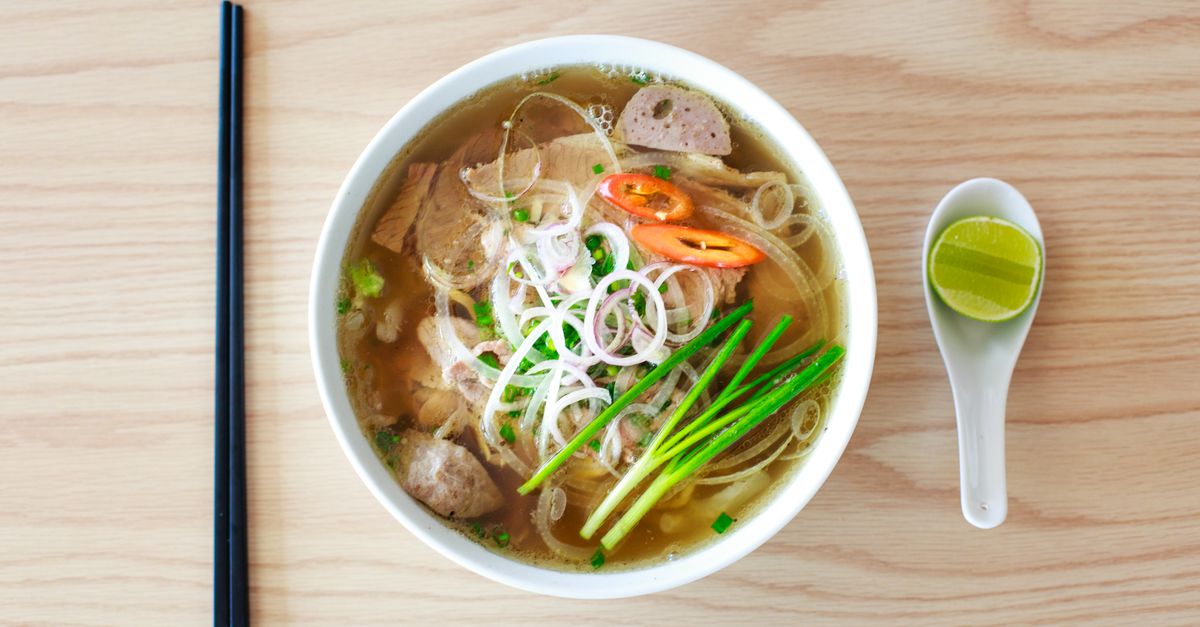
Vietnamese cooking is built on balance: salty fish sauce, sour lime, sweet palm sugar, a little chilli heat and fistfuls of fresh herbs. Much of the best food is cooked on the pavement and eaten on knee-high stools, so arrive hungry and curious.
Signature dishes to try first
- Pho: rice noodle soup with beef or chicken in a long-simmered broth, usually eaten for breakfast. Northern bowls are clean and simple; in the south you add bean sprouts, basil and sauces yourself.
- Banh mi: a crackly baguette, a legacy of the French era, stuffed with pâté, cold cuts or grilled pork, pickled carrot and radish, coriander and chilli.
- Bun cha: Hanoi's lunchtime favourite of chargrilled pork patties and belly in a sweet-sour dipping broth, served with cold rice vermicelli and herbs.
- Banh xeo: a crisp turmeric-yellow pancake filled with pork, prawns and bean sprouts, wrapped in lettuce or rice paper and dipped in sauce.
- Goi cuon: fresh rice-paper rolls packed with prawns, pork, herbs and noodles.
Get your Vietnam eSIM in 30 seconds
Instant delivery, 4G/5G speeds, no roaming bills.
Regional specialities from north to south
Each region cooks differently, so eat your way down the map.
- Hanoi and the north: cha ca, turmeric-marinated fish fried at the table with heaps of dill and spring onion, and bun rieu, a tangy crab and tomato noodle soup.
- Hue: bun bo Hue, a punchy lemongrass and chilli beef noodle soup, plus delicate steamed rice cakes inspired by the old royal kitchens.
- Hoi An and Da Nang: cao lau, chewy noodles with pork, greens and crunchy crackers in very little broth, and mi Quang, flat turmeric noodles with prawns, pork and peanuts.
- Ho Chi Minh City and the Mekong Delta: com tam, broken rice topped with a grilled pork chop and a fried egg, hu tieu noodle soup and a dazzling range of tropical fruit.
How street food works
Look for stalls that specialise in one dish and are busy with locals. Sit down, point at what others are eating or say the name of the dish, and pay when you leave. A basket of herbs, chillies, lime wedges and sauces usually sits on the table so you can season your bowl.
In tourist-heavy streets, ask the price before ordering. Wet towels and plates of peanuts placed on the table are sometimes added to the bill, so leave them untouched if you don't want them.
Coffee, beer and other drinks
Vietnam is one of the world's biggest coffee producers. Try ca phe sua da, strong coffee dripped through a small metal phin filter over condensed milk and ice, or Hanoi's famous egg coffee, topped with a whipped yolk-and-sugar cream that tastes like custard. Coconut coffee and salted coffee are popular twists.
For something lighter, street stalls serve iced green tea, freshly pressed sugar cane juice and fruit smoothies. In Hanoi, don't miss bia hoi, a light draught beer brewed fresh each day and poured at crowded street corners. At village homestays you may be offered home-made rice wine; sip it slowly and join the toast of "mot, hai, ba, yo!" (one, two, three, cheers).
Table manners and tipping
Meals are shared, with everyone taking a little at a time from dishes in the middle. It is normal to lift your rice bowl close to your mouth, but never leave chopsticks standing upright in rice, as it recalls incense at a funeral. If you are invited out, the host normally pays; offering is polite, while insisting can cause embarrassment.
Tipping is not a traditional part of eating out in Vietnam. Rounding up the bill or leaving small change is appreciated, and some upmarket restaurants add a service charge, so check the bill before adding more.
Vegetarian diets, allergies and spice
Vegetarians do well thanks to Buddhist restaurants marked chay, often found near pagodas. Many Vietnamese eat meat-free on the first and fifteenth days of the lunar month, when these places are especially busy. Elsewhere, fish sauce and shrimp paste turn up in a lot of dishes, so learn "toi an chay" (I eat vegetarian) and "khong nuoc mam" (no fish sauce).
Peanuts, shellfish and soy appear often, so carry a card written in Vietnamese that explains any serious allergy. Most food is not very spicy, as chilli usually comes on the side, though dishes from Hue pack more heat.
Stay connected in Vietnam
Vietnam's best food often hides down alleys with no English sign, so live maps, recent reviews and a camera translation app make a real difference. With a HelloSIM eSIM you can look up a dish, translate a handwritten menu or order delivery through Grab wherever you are. It is a data-only plan that you install before you fly and that connects once you land.
Get your Vietnam eSIM in 30 seconds
Instant delivery, 4G/5G speeds, no roaming bills.