
Thailand has a reputation for easy-going warmth, and most locals forgive a visitor's small mistakes. Still, a few customs run deep, and knowing them will make every interaction smoother and more rewarding.
Greetings and the wai
The traditional greeting is the wai: palms pressed together at chest height with a slight bow of the head. The younger or more junior person usually offers it first, and the higher the hands, the more respect it shows. Return a wai when one is offered, but you don't need to wai shop staff or waiters; a smile and a nod are fine. Handshakes are common in business settings.
Smiles do a lot of work in Thai communication, and keeping calm is highly valued. Raising your voice or showing anger in public causes everyone to lose face and rarely gets results. The phrase "jai yen yen" (keep a cool heart) sums up the ideal.
Get your Thailand eSIM in 30 seconds
Instant delivery, 4G/5G speeds, no roaming bills.
Buddhism, temples and monks
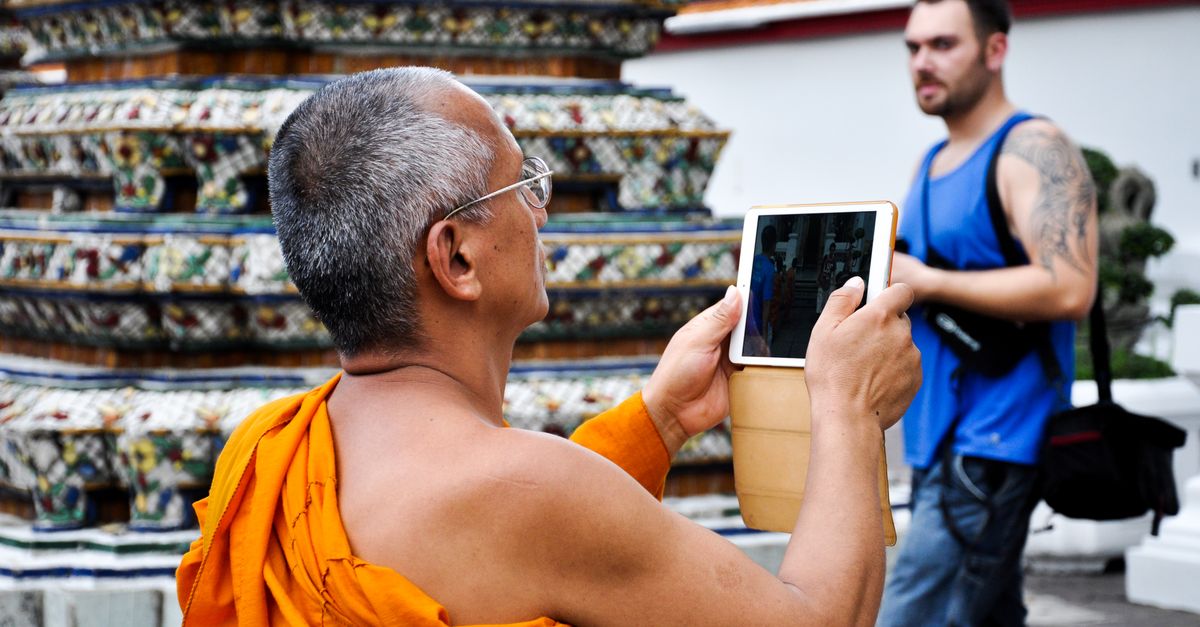
Most Thais are Theravada Buddhists, and temples (wat) are active places of worship as well as sights.
- Cover shoulders and knees; a sarong or light scarf in your bag solves most problems.
- Take your shoes off before entering a temple building, and step over the raised threshold rather than on it.
- Never point your feet at a Buddha image or a monk; sit with your legs tucked to the side.
- Women should avoid touching monks or handing things to them directly; place the item down instead.
- Buddha images are sacred, so don't climb on them, pose disrespectfully beside them or treat them as décor.
The strictest dress code is at the Grand Palace in Bangkok, where visitors in shorts, sleeveless tops or ripped trousers are turned away.
Heads, feet and everyday manners
The head is considered the highest part of the body and the feet the lowest. In practice:
- Don't touch anyone's head, even a child's.
- Don't point with your feet, rest them on tables or use them to move objects.
- Remove shoes when entering homes and some shops, guesthouses and massage studios; a pile of shoes at the door is your cue.
- Point or beckon with your whole hand, palm down, rather than a single finger.
- Keep public displays of affection low-key, especially outside the big tourist areas.
Away from the beach, Thais dress neatly, and swimwear in towns or shopping centres draws disapproving looks. Going topless on the beach is frowned upon too.
Respect for the monarchy
The Thai royal family is held in the highest esteem. Avoid jokes or critical comments about the monarchy, even in casual conversation. The king's image appears on banknotes and coins, so never step on money to stop it blowing away. In cinemas, the royal anthem plays before the film and audiences stand, and in many public places people pause when the national anthem plays each morning and evening.
Social life and hospitality
Thais often ask friendly personal questions, such as where you are from or whether you are married; it is small talk, not prying. If you are invited to someone's home, bring a small gift such as fruit or sweets and take your shoes off at the door. When dining in a group, the most senior person often pays, and splitting the bill item by item is less common than at home.
Useful Thai phrases
Polite particles matter: men end sentences with khrap, women with kha.
- Sawasdee khrap / kha: hello, goodbye
- Khop khun khrap / kha: thank you
- Mai pen rai: never mind, no problem
- Tao rai?: how much?
- Hong nam yoo tee nai?: where is the toilet?
Even a clumsy attempt at these is usually met with delight.
Stay connected in Thailand
A translation app helps when you want to read a temple's notice about dress, ask a vendor a question or check the meaning of a ceremony you have stumbled upon. Mobile data also lets you look up a temple's history while you stand in front of it. A HelloSIM eSIM gives you data-only access across Thailand: it installs before you fly, connects once you arrive and leaves your own number on the phone for calls and messages.
Get your Thailand eSIM in 30 seconds
Instant delivery, 4G/5G speeds, no roaming bills.