
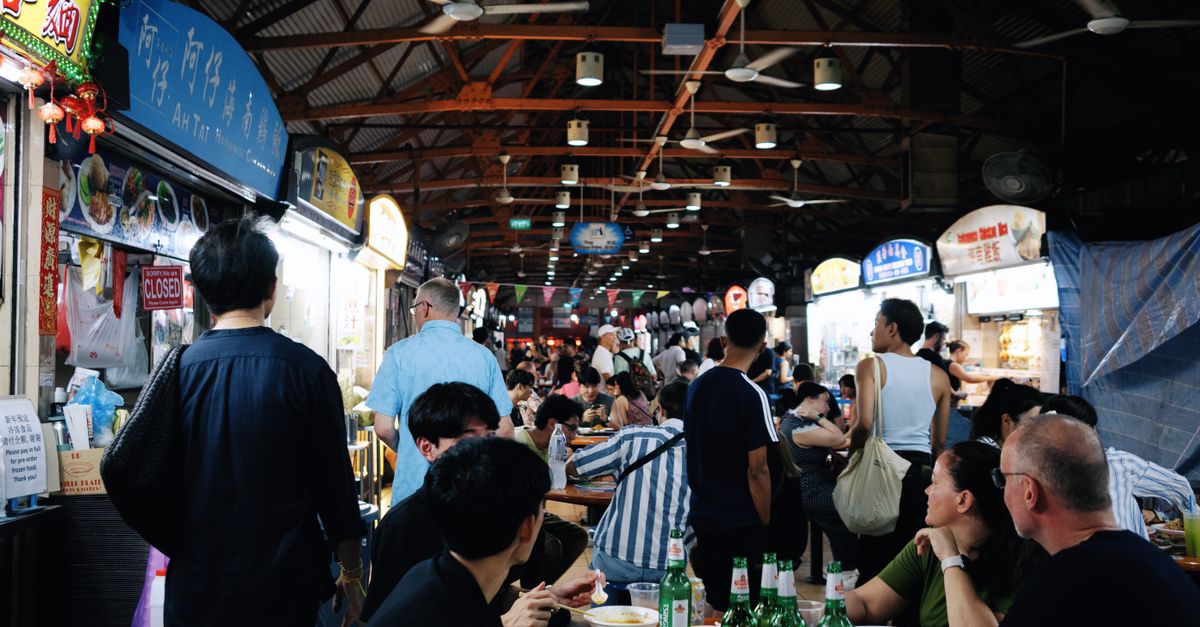
Eating is close to a national pastime in Singapore, and much of the best food is served not in expensive dining rooms but at shared tables in open-air food centres. Chinese, Malay, Indian and Peranakan cooking sit side by side, often under the same roof. Here is what to order, where to find it and how to fit in while you eat.
Hawker centres: where Singapore eats
Hawker centres are covered food courts packed with small stalls, each usually specialising in one or two dishes. Singapore's hawker culture was added to UNESCO's list of Intangible Cultural Heritage in 2020, and eating at one is the quickest way to understand the city.
Good places to start include Maxwell Food Centre in Chinatown, Lau Pa Sat in the business district (where Boon Tat Street becomes a satay street in the evening), Old Airport Road Food Centre, Tekka Centre in Little India and Newton Food Centre.
Follow the longest queue of locals rather than the biggest sign. Stalls often close one or two days a week, so have a backup in mind.
Get your Singapore eSIM in 30 seconds
Instant delivery, 4G/5G speeds, no roaming bills.
Signature dishes to try
- Hainanese chicken rice: poached or roasted chicken over rice cooked in chicken stock, with chilli-garlic sauce and ginger. Often called the national dish.
- Laksa: noodles in a rich, spicy coconut-curry broth; the Katong style uses short-cut noodles eaten with a spoon.
- Chilli crab: whole crab in a sweet, tangy tomato-and-chilli gravy, best mopped up with fried mantou buns. Black pepper crab is the punchier alternative.
- Char kway teow: flat rice noodles wok-fried with dark soy, egg, cockles and Chinese sausage.
- Hokkien mee: prawns, squid and noodles braised in prawn stock, served with sambal and lime.
- Satay: grilled skewers of chicken, mutton or beef with peanut sauce, cucumber and onion.
- Nasi lemak: coconut rice with sambal, crispy anchovies, peanuts and egg.
- Roti prata: flaky griddled flatbread served with curry for dipping.
- Bak kut teh: peppery pork-rib broth with rice and fried dough sticks.
Breakfast, snacks and desserts
A classic local breakfast is kaya toast, grilled bread spread with coconut-egg jam and butter, served with two soft-boiled eggs seasoned with soy sauce and white pepper. Through the day, snack on curry puffs, chwee kueh (steamed rice cakes topped with preserved radish) or fried carrot cake, which is actually radish cake stir-fried with egg. For dessert, try ice kachang or chendol, both piled over shaved ice. Adventurous eaters can seek out durian, the pungent "king of fruits", which is most plentiful around the middle of the year. Eat it at the stall: it is not welcome on public transport or in most hotels.
What to drink
Ordering coffee at a kopitiam (traditional coffee shop) has its own vocabulary:
- Kopi: coffee with sweetened condensed milk.
- Kopi-O: black coffee with sugar; add kosong for no sugar.
- Kopi-C: with evaporated milk and sugar.
- Siew dai means less sweet, and peng means iced.
Swap "kopi" for "teh" and the same codes work for tea. Teh tarik, a frothy pulled milk tea, is a must, as are fresh sugarcane juice, lime juice and barley water. Alcohol is relatively expensive, so many locals drink beer at hawker centres rather than in bars. The Singapore Sling, a gin-based cocktail created in the city in the early 20th century, is the famous splurge.
Etiquette, tipping and paying
- Chope: a packet of tissues on a table means it is reserved. Find another seat or ask to share; sharing tables is normal.
- Return your tray: clearing your own tray and crockery is expected at hawker centres and food courts.
- No tipping: tips are not expected. In restaurants, prices marked "++" will have a service charge and GST added.
- Paying: many stalls accept cards or QR payments, but carry small notes for older stalls.
Dietary notes
If you eat halal, look for the halal certificate displayed at the stall; many Malay and Indian stalls have one. Many Chinese dishes use pork or lard, so ask if unsure. Vegetarians do well in Little India and at Buddhist vegetarian stalls. Common allergens include peanuts, shellfish and belacan (fermented shrimp paste), which hides in sambal and many sauces. Ask for "less spicy" if chilli is a concern.
Stay connected in Singapore
With mobile data you can check whether a stall is open today, read recent reviews, find the nearest food centre and look up an unfamiliar dish while you queue. A HelloSIM eSIM gives you data only, so your home number and WhatsApp carry on as normal. Set it up at home before your flight and it connects when you arrive.
Get your Singapore eSIM in 30 seconds
Instant delivery, 4G/5G speeds, no roaming bills.