
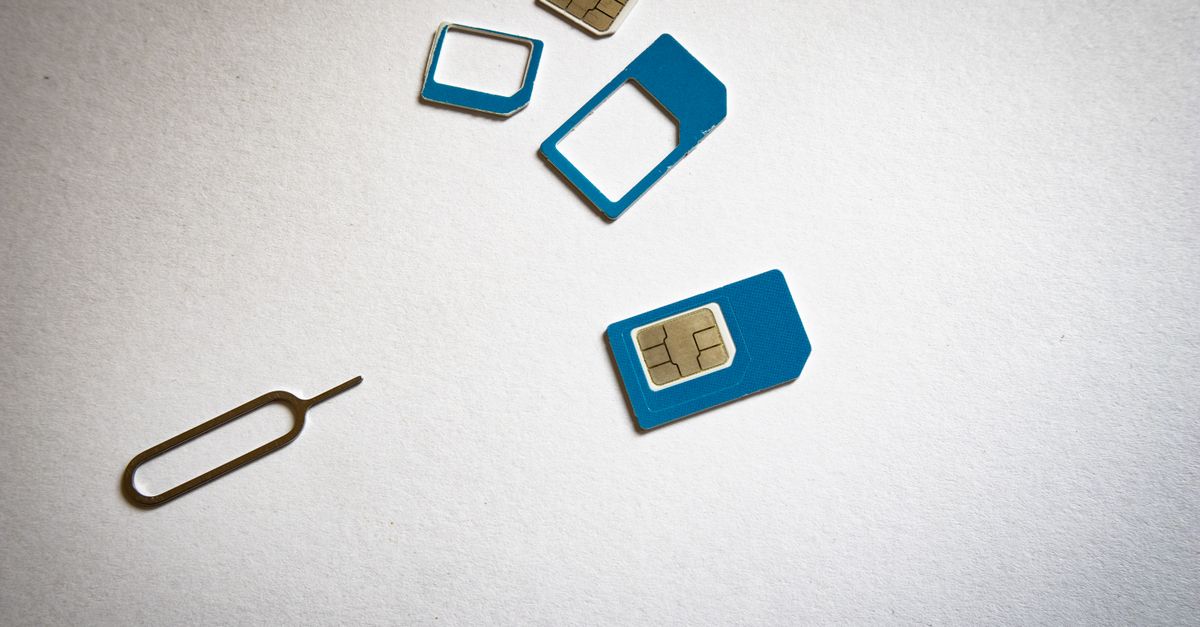
A SIM, whether it's a plastic card or built into the phone, has one main job: proving to a mobile network that your phone is allowed on, and on which plan. Where that proof lives changes how you buy it, how you swap it and what happens if your phone goes missing. It doesn't change what the connection can do once you're online.
The short version
- Physical SIM: a removable card with a chip, slotted into a tray in the phone. You buy it in a shop or receive it by post, and you can move it from one phone to another.
- eSIM: a chip built permanently into the phone that stores downloadable profiles. You add a plan by scanning a QR code or entering a couple of codes, with no card involved.
- Both connect to the same networks in the same way, using 4G or 5G where the network and the phone support it.
- Many phones now accept one of each, or several eSIM profiles, which is what makes eSIMs so handy for travel.
Form: a card you hold versus a profile you download
Physical SIMs have shrunk over the years, from standard to micro to today's nano size, but they are still a card that has to fit the tray in your phone. The eSIM chip, by contrast, is fixed inside the device and never comes out. What changes is the profile written to it: a small package of identity details and network settings downloaded from the provider's server.
That's why buying an eSIM gets you a QR code rather than a parcel. Scanning it tells the phone where to fetch the profile (the SM-DP+ address) and which profile is yours (the activation code). The phone downloads it over Wi-Fi, and a new line appears in Settings alongside any you already have.
Get your United Kingdom eSIM in 30 seconds
Instant delivery, 4G/5G speeds, no roaming bills.
Getting one: shop counter, post or inbox
A physical SIM has to reach you physically. At home that's simple enough. Abroad it can mean finding a shop or kiosk, possibly showing ID, depending on local rules, and working through menus or a conversation in another language, often just after a long journey. A travel SIM card ordered in advance needs time to be posted.
An eSIM arrives digitally. With HelloSIM, for example, the QR code is emailed straight after payment and also kept in your account and in the app. You can buy days ahead, install at home on Wi-Fi and walk off the plane with the line ready. Checkout works as a guest with only an email address.
Switching and multiple profiles
Swapping physical SIMs means finding a pin tool, handling a card smaller than a fingernail and remembering where you put the one you took out. Switching between eSIM lines is a menu choice.
Most eSIM phones can store more than one eSIM profile, although how many can be active at the same time depends on the model. A common arrangement is a physical SIM plus an eSIM, or two eSIMs, both active at once. This dual SIM setup lets you:
- keep your home number switched on for calls and texts;
- use a travel eSIM for mobile data;
- decide, line by line, which one handles data, calls and messages.
Profiles you're not using at the moment can simply be switched off rather than deleted.
Security and loss
A physical SIM can be ejected in seconds. If a phone is stolen, someone can take the card out and put it in another handset to receive your texts, which is one good reason to set a SIM PIN.
An eSIM can't be pulled out of a phone and slipped into another one, which removes that particular risk. It can't fall out of a wallet, get swapped by mistake or go missing in a hotel room either.
The flip side is that the profile belongs to that phone. If your handset breaks, you can't just move the eSIM to a spare one the way you'd move a card. A travel eSIM such as HelloSIM's is installed on one phone, and its QR code is intended for a single installation, so treat the code like a key: don't share it or post a photo of it.
Which works better for travel?
For most travellers with a recent, unlocked phone, an eSIM is the more convenient option:
- no searching for a shop after you land;
- your home SIM stays in the phone, so your number keeps receiving calls and texts;
- no tiny card to lose or damage;
- everything can be set up before you leave home;
- more data can be added to the same eSIM later without reinstalling it.
A physical SIM still has the edge in a few situations:
- your phone doesn't support eSIM, or it's locked to one carrier;
- you have one of the iPhones sold in mainland China, Hong Kong or Macao, many of which use two physical SIM slots instead of eSIM;
- you regularly move the same line between several devices.
To check your own phone, look in Settings for an option such as "Add eSIM", under Mobile Data on iPhone or under SIMs or SIM manager on Android. Typical eSIM phones include the iPhone XS and XR and newer, Google Pixel 3 and newer, and recent Samsung Galaxy S and Z models plus many A models.
Do you have to choose one or the other?
Not really. On a dual SIM phone the two work side by side, and that pairing, a home SIM for your number and an eSIM for travel data, is how most people use a travel eSIM. HelloSIM eSIMs are data-only, with no local phone number, so calls and messages run through apps such as WhatsApp, FaceTime or Telegram while your regular number stays exactly where it is.
Your WhatsApp account isn't affected either. It stays registered to your usual number; the eSIM simply supplies the data it runs on.
Get your Europe eSIM in 30 seconds
Instant delivery, 4G/5G speeds, no roaming bills.