
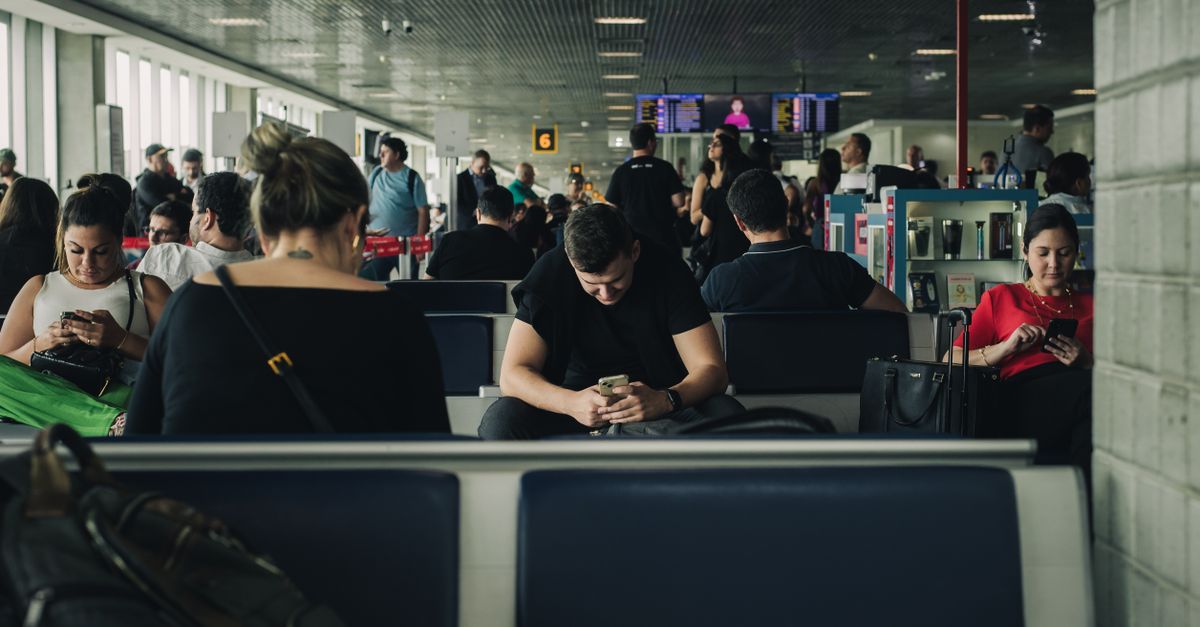
Planning a trip overseas and wondering what your phone will cost you once you land? For most Americans the default is the carrier's international day pass, and on a two-week vacation those daily charges pile up. This guide explains how roaming from the US usually works, how a data-only travel eSIM fits alongside your regular line, and how to get set up for Europe, Mexico, Canada, the UK and Japan before you leave.
Roaming from the US: what it usually costs
Major US carriers commonly offer international roaming as a day pass. You keep your normal plan, and each day you use your phone abroad a fee lands on your bill. Those passes often cost around $10 or more per day, so check your current tariff, because terms vary from plan to plan and change over time. Fine for a weekend in Toronto; less so for ten days in Italy.
The catch is what counts as a "day." On many day-pass plans, any use can trigger the charge, including an app quietly refreshing in the background. Whether Canada and Mexico are included depends on your plan too, so look it up rather than assuming. With no pass at all, pay-per-use roaming rates can get very expensive.
Cruises add one more twist. Out at sea, your phone can latch onto the ship's own maritime network, which is billed separately from normal roaming and can be very expensive, even between islands your plan covers on land.
How a travel eSIM works
A travel eSIM is a second, digital line that you add to your phone. HelloSIM eSIMs are data-only: they give you mobile data at your destination, but there's no local phone number attached and no regular calling or texting. Your US SIM stays put, so your own number is still there for calls and texts whenever you want it. WhatsApp stays tied to your usual number, and calls back home simply go over data with FaceTime, WhatsApp, Telegram or Viber.
Set it up on home Wi-Fi a few days before your flight. Buying early costs you nothing in validity: the plan's days only begin to count once the eSIM connects to a network at your destination for the first time. If you run low halfway through the trip, top up the same eSIM with more data without reinstalling anything.
Get your Europe eSIM in 30 seconds
Instant delivery, 4G/5G speeds, no roaming bills.
Popular destinations for US travelers
Europe
Paris, Rome and Barcelona in two weeks, or London followed by Amsterdam on the train, is exactly where one regional plan earns its keep. The Europe plan spans more than 40 countries, from all the big EU destinations to the UK and Switzerland, so crossing a border doesn't mean changing anything on your phone. Save offline maps for each city as a backup for underground stations where signal can fade.
Mexico
Cancún, Tulum, Los Cabos and Mexico City draw Americans all year, especially around spring break and the winter holidays. Install a Mexico plan before you fly, switch the line on as the plane taxis in, and you can message your shuttle or open a ride app before you reach the arrivals hall.
Get your Mexico eSIM in 30 seconds
Instant delivery, 4G/5G speeds, no roaming bills.
Canada
A long weekend in Montreal, a drive up to Vancouver or a fall foliage trip through Quebec feels so close to home that it's easy to forget your phone is roaming. A Canada plan keeps navigation running on a road trip through the Rockies, but long remote highways can have gaps in coverage, so download offline maps before you leave town.
United Kingdom
London is often the first stop on a European trip. If the UK is your only destination, a United Kingdom plan does the job; if you're continuing to Paris on the Eurostar or flying on to Lisbon, the Europe plan includes the UK as well, so one eSIM covers the whole itinerary.
Japan
Japan has become a bucket-list trip for a lot of Americans, from cherry blossom season to fall colors in Kyoto. Train transfers, translation apps, restaurant bookings and maps all need a connection, so you'll use more data than you expect. Install your Japan plan at home and you can be checking train times on the airport platform instead of hunting for Wi-Fi.
Get your Japan eSIM in 30 seconds
Instant delivery, 4G/5G speeds, no roaming bills.
Caribbean cruise ports
Nassau, Cozumel and Montego Bay are regular stops on Caribbean cruises, and they're where your phone needs care. At sea, keep data roaming off on your US line, or use airplane mode with Wi-Fi, so it doesn't latch onto the ship's network. Treat a travel eSIM as your connection in port, not on open water, and check which countries your itinerary visits before choosing between a country plan and HelloSIM's Caribbean regional plan.
Is your phone ready for eSIM?
Two boxes need checking: the phone has to support eSIM, and it has to be unlocked. Support is the easy part on most recent models: anything from iPhone XS or XR onward, Google's Pixel 3 or later, and recent Samsung Galaxy S, Z and many A-series phones. To be sure, open Settings and look for an "Add eSIM" option.
The unlock is where many Americans get tripped up. If you bought your phone on an installment plan from your carrier, it may stay carrier-locked until it's paid off, and a locked phone won't accept another provider's eSIM. Ask your carrier to unlock it well before your trip, not the night before your flight.
Before you fly: step by step
- 1Make sure your phone supports eSIM and is unlocked.
- 2Choose a country plan for a single destination, or the Europe plan for a multi-country trip, with enough data and days for your dates.
- 3Check out with just your email; no account needed. Your QR code is emailed to you straight away.
- 4At home on Wi-Fi, open Settings → Cellular → Add eSIM and scan the QR code. Android users will find Add eSIM under Settings → Network & internet or Connections → SIMs or SIM manager.
- 5Label the new line something like "Travel" so it's easy to spot, and leave it switched off until you land.
- 6On arrival, switch the HelloSIM line on, pick it as your cellular data line and enable Data Roaming on it. That's required, and it costs nothing extra because the data is prepaid.
- 7On your US line, switch Data Roaming off to avoid home roaming charges.
How much data to buy
- Maps, messages and a few emails each day: plan on roughly 1 GB a week.
- Scrolling social feeds, browsing and posting photos: 3–5 GB a week is typical.
- Streaming, video calls or remote work: allow 10 GB or more per week.
- A two-week Europe trip with everyday use: somewhere around 6–10 GB on the Europe plan.
- A cruise with several port days: data needs are modest, but make sure the plan's number of days covers the stretch from your first port to your last.
Paying and getting help
Checkout accepts Visa, Mastercard and American Express cards, Apple Pay, Google Pay and your HelloSIM wallet balance. Prices are set in euros and your bank converts the charge to dollars for you; for a rough idea beforehand, switch the site's display to USD. If your card adds a foreign transaction fee, it may apply here too, so a no-fee travel card is the one to use.
The QR code hits your inbox straight away and is also saved in your HelloSIM account and the HelloSIM iPhone app. If anything goes wrong, reach support on WhatsApp or write to [email protected]; email replies come within 24 hours. All sales are final once the eSIM is delivered, except for a verified technical fault that support can't fix and on which no data was used.
Get your Europe eSIM in 30 seconds
Instant delivery, 4G/5G speeds, no roaming bills.