
Getting around the UAE is straightforward once you know how each emirate works. Dubai has the most developed public transport, the rest of the country relies more on buses, taxis and roads, and the distances between cities are short.
From the airport to the city
- Dubai International (DXB): the Dubai Metro Red Line stops at Terminals 1 and 3, and official taxis wait outside every terminal. Terminal 2 is served by buses and taxis rather than the metro.
- Zayed International (AUH): Abu Dhabi's main airport is roughly half an hour's drive from the city centre, linked by taxis, ride apps and public buses.
- Sharjah International (SHJ): popular with low-cost airlines, with taxis and buses into Sharjah and on to Dubai.
- Al Maktoum International (DWC): further out in Dubai South with fewer flights, so allow extra time for the ride into town.
Get your United Arab Emirates eSIM in 30 seconds
Instant delivery, 4G/5G speeds, no roaming bills.
Dubai Metro, tram and Nol cards
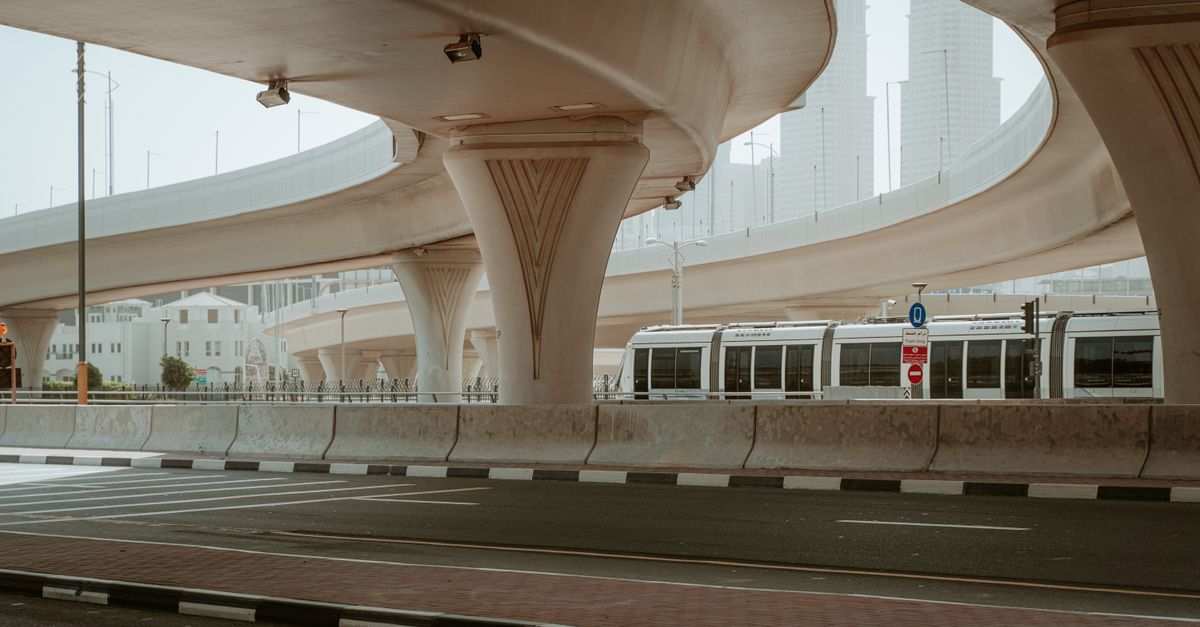
The driverless Dubai Metro's Red and Green lines run along Sheikh Zayed Road and through Deira and Bur Dubai. The Dubai Tram loops around Dubai Marina and JBR and connects with the metro.
- Pay with a Nol card, a rechargeable smart card sold at stations. The same card works on the metro, tram, city buses and water buses. Tap in and out every time.
- Fares depend on how many zones you cross. Gold Class carriages cost more and are quieter.
- Each train has a section reserved for women and children, clearly marked on the platform.
- Eating, drinking and chewing gum aren't permitted on board.
Taxis and ride apps
- Metered taxis are plentiful in Dubai, Abu Dhabi and Sharjah. Cards are widely accepted, but carry some small notes just in case.
- Careem and Uber both operate and can book regular taxis as well as private cars, with the fare estimate shown before you ride.
- In Dubai, women and families can request taxis driven by women, recognisable by their pink roofs.
- Stick to official taxis or app bookings, and ignore drivers touting rides at airports or mall exits.
Buses and travel between emirates
- Air-conditioned city buses cover Dubai and Abu Dhabi; Abu Dhabi uses its own Hafilat card rather than Nol.
- Intercity buses link Dubai with Abu Dhabi, Sharjah, Al Ain, Ras Al Khaimah, Fujairah and Hatta from the main bus stations. They're inexpensive and comfortable, though slower than a taxi.
- Water transport adds variety in Dubai: abras across the Creek, water buses and the Dubai Ferry along the coast.
- A national passenger rail service has been in development, so check whether it serves your route before you travel.
Renting a car and driving
- Traffic drives on the right, roads are excellent and signs are in Arabic and English. A car is the easiest way to reach the mountains, the east coast and Liwa.
- Ask your rental company which licence or permit you need for your nationality before you book.
- Speed cameras are everywhere and limits are strictly enforced. Tailgating and sudden lane changes are common, so drive defensively.
- Dubai's Salik and Abu Dhabi's Darb toll systems charge electronically, and rental firms usually bill tolls afterwards.
- If you're driving, don't drink any alcohol at all.
Stay connected in the United Arab Emirates
Transport here runs on your phone: ride apps, live traffic, metro journey planners and rental-car navigation all need data. A HelloSIM eSIM lets you book a ride from arrivals without relying on airport Wi-Fi. It's data-only, so your home SIM stays on for calls and texts. Install it before you fly, then switch it on and turn on data roaming for that line when you land. If your route continues to neighbouring countries, a regional plan can cover more of the trip; check which countries it includes.
Get your Middle East & North Africa eSIM in 30 seconds
Instant delivery, 4G/5G speeds, no roaming bills.
Get your United Arab Emirates eSIM in 30 seconds
Instant delivery, 4G/5G speeds, no roaming bills.