
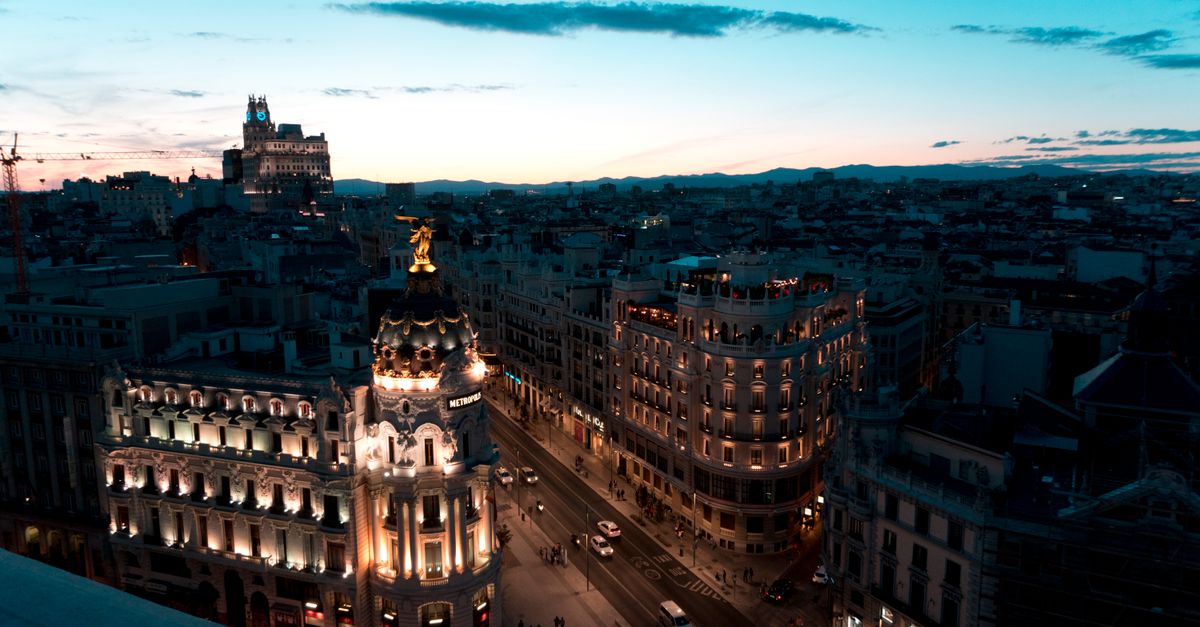
Spain rewards travellers who move around. Its big cities feel strikingly different from one another, in food, language, architecture and even the hour people sit down to dinner, and fast trains make it easy to combine two or three in a single trip. Here is how to choose.
Madrid and Barcelona: the two heavyweights
Madrid
Best for: first-time visitors, art lovers and night owls. Madrid sits in the middle of the country and is the hub of the high-speed rail network, which makes it a natural starting point.
- The so-called Golden Triangle of art: the Prado, the Reina Sofía (home of Picasso's Guernica) and the Thyssen-Bornemisza, all within walking distance of each other.
- A rowing boat on the lake in Retiro Park, then tapas and late drinks around La Latina and Malasaña.
Barcelona
Best for: architecture fans and anyone who wants a city break with a beach attached. Catalan is spoken alongside Spanish, and the city moves to a distinctly Mediterranean rhythm.
- Gaudí's buildings, above all the Sagrada Família and Park Güell, both of which need timed tickets booked ahead.
- Wandering the Gothic Quarter and El Born, then heading down to the seafront at Barceloneta.
Get your Spain eSIM in 30 seconds
Instant delivery, 4G/5G speeds, no roaming bills.
Andalusia: Seville, Granada and Málaga
The south is the Spain of flamenco, orange trees and Moorish palaces, and its three star cities sit close enough to string together in a week.
Seville
Best for: couples and anyone chasing atmosphere. Don't miss the Real Alcázar, the cathedral with its Giralda bell tower, Plaza de España at golden hour and a flamenco show in the Triana district across the river. Avoid July and August if you can, as inland Andalusia gets fiercely hot.
Granada
Best for: history lovers and travellers watching their spending. The Alhambra is the reason most people come, and tickets often sell out weeks ahead. Watch the sunset from the Mirador de San Nicolás in the hilly Albaicín, and enjoy the local custom of a free tapa with each drink in many bars.
Málaga
Best for: winter sun and relaxed city-plus-beach stays. Picasso was born here, and the Picasso Museum and the hilltop Alcazaba fortress are the big draws. It also makes an easy base for the Costa del Sol and a day trip inland to Ronda.
Valencia: space, science and the real paella
Best for: families, cyclists and food lovers. Valencia is Spain's third-largest city but feels far more laid-back than Madrid or Barcelona.
- The futuristic City of Arts and Sciences, reached on foot or by bike through the Turia Gardens, a long park laid out in an old riverbed.
- Paella was born in this region. Order it at lunchtime, the traditional time to eat it, ideally near the rice fields of La Albufera just south of the city.
San Sebastián and the Basque Country
Best for: serious eaters and lovers of coastal scenery. San Sebastián (Donostia in Basque) packs an extraordinary number of pintxos bars into its old town, the Parte Vieja, and the curving La Concha beach is perfect for a morning swim or an evening stroll. Bilbao, home of the Guggenheim Museum, is around an hour and a quarter away by bus, so it is easy to see both.
How the cities link up
Spain's high-speed trains do most of the heavy lifting, with Madrid as the hinge:
- Madrid to Barcelona, Seville or Málaga: around two and a half to three hours.
- Madrid to Valencia: under two hours on the fastest services.
- Seville to Córdoba: well under an hour, so the Mezquita makes an easy stop.
- Granada: direct trains from Madrid, plus trains and coaches from Seville and Málaga.
- San Sebastián: the longest hop from Madrid at several hours by train, so many visitors fly into Bilbao instead.
A classic first trip runs Madrid, then Andalusia, finishing in Barcelona. A second visit could pair the Basque Country with Valencia. Book high-speed tickets early, as fares tend to climb as departure day approaches.
Stay connected in Spain
City-hopping means checking platforms, finding your apartment in a maze of old-town lanes and booking that Alhambra slot on the go. A HelloSIM eSIM gives you mobile data for all of it: it is data-only, so your own number stays active for calls and texts, you install it at home before you leave, and it connects once you arrive. If Portugal or France is on the same itinerary, a regional plan covers several countries with one eSIM.
Get your Europe eSIM in 30 seconds
Instant delivery, 4G/5G speeds, no roaming bills.
Get your Spain eSIM in 30 seconds
Instant delivery, 4G/5G speeds, no roaming bills.