
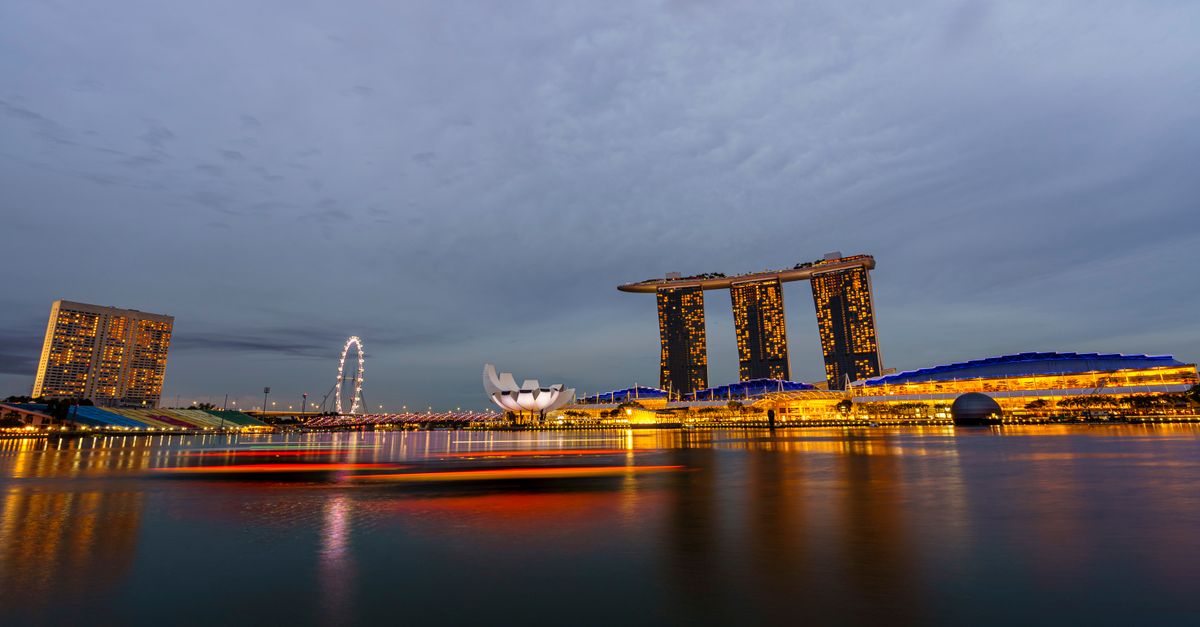
Singapore is a single city-state, yet a short MRT ride can take you from glass towers to Hindu temples, Art Deco housing estates and a rural island where people still cycle past wooden village houses. Rather than choosing between cities, you choose between neighbourhoods, and each one suits a different kind of traveller.
Marina Bay and the Civic District
Best for first-timers, short stopovers and anyone who wants the postcard views. The bay is ringed by the sights that define the skyline: the Supertree Grove at Gardens by the Bay, the Merlion spouting water towards the towers, and the spiky twin domes of the Esplanade arts centre. Come back after dark, when the Supertrees glow and the waterfront promenade fills with people.
Next door, the Civic District holds colonial-era landmarks around the Padang. The National Gallery Singapore, set inside the former Supreme Court and City Hall, and the Asian Civilisations Museum by the river are ideal for a hot or rainy afternoon.
Get your Singapore eSIM in 30 seconds
Instant delivery, 4G/5G speeds, no roaming bills.
Chinatown and Tanjong Pagar
Best for food lovers, budget travellers and evenings out. Chinatown mixes restored shophouses, temples and two of the city's best-known hawker centres, Maxwell Food Centre and Chinatown Complex. Within a few streets you will find the Buddha Tooth Relic Temple, the Sri Mariamman Temple (Singapore's oldest Hindu temple) and, on Telok Ayer Street, the ornate Thian Hock Keng Temple.
Neighbouring Tanjong Pagar, with the lanes around Keong Saik Road and Club Street, turns lively at night, with cocktail bars and small restaurants tucked into heritage buildings.
Little India and Kampong Glam
Best for culture, photography and good-value stays. Little India centres on Serangoon Road, with flower-garland stalls, spice shops, the colourful Sri Veeramakaliamman Temple and Tekka Centre for South Indian food. During Deepavali the whole area is strung with lights.
A short walk away, Kampong Glam is the historic Malay and Arab quarter. The golden dome of Sultan Mosque rises above Arab Street and pedestrianised Bussorah Street, while narrow Haji Lane is lined with murals, independent boutiques and cafes.
Orchard Road and the Botanic Gardens
Best for shoppers, families and travellers who like a polished base. Orchard Road is a long boulevard of malls that turns into a festival of lights at Christmas. When the crowds get too much, escape to the Singapore Botanic Gardens, a UNESCO World Heritage Site with the National Orchid Garden inside, a short ride away at the MRT station of the same name.
Sentosa, Tiong Bahru, Katong and Pulau Ubin
- Sentosa: the resort island for beaches, Universal Studios Singapore and family days out. Walk the boardwalk from VivoCity, ride the Sentosa Express monorail or take the cable car from Mount Faber.
- Tiong Bahru: low-rise 1930s Art Deco flats, a much-loved market with a hawker floor upstairs, and independent cafes and bookshops. Ideal for slow mornings.
- Katong and Joo Chiat: pastel Peranakan terraces, bowls of Katong laksa and easy access to the seaside cycling paths of East Coast Park.
- Pulau Ubin: a bumboat from Changi Point Ferry Terminal takes you to a quiet island of bike trails, old kampong houses and the Chek Jawa Wetlands. Best for nature lovers and cyclists.
How the neighbourhoods link up
The MRT ties almost everything together. Bayfront, Chinatown, Little India and Bugis (for Kampong Glam) all sit on the Downtown Line; the Thomson-East Coast Line connects Orchard, Marina Bay and Katong; and the Circle Line swings round to the Botanic Gardens and HarbourFront for Sentosa. Buses and ride-hailing apps such as Grab fill the gaps, and covered walkways make short hops bearable even at midday.
Many travellers also pair Singapore with its neighbours. Johor Bahru in Malaysia is just across the Causeway by bus or a short shuttle train, and ferries cross to the Indonesian islands of Batam and Bintan. Check the entry requirements for each country before you go.
Stay connected in Singapore
Hopping between neighbourhoods is easiest with live data: MRT route planning, bus arrival times and a quick Grab booking when a storm rolls in all happen on your phone. A HelloSIM eSIM is data-only, so your own number stays on your home SIM for calls and texts while WhatsApp keeps working as usual. Install it over Wi-Fi before you leave and it connects once you land at Changi.
Get your Asia Pacific eSIM in 30 seconds
Instant delivery, 4G/5G speeds, no roaming bills.
Get your Singapore eSIM in 30 seconds
Instant delivery, 4G/5G speeds, no roaming bills.